


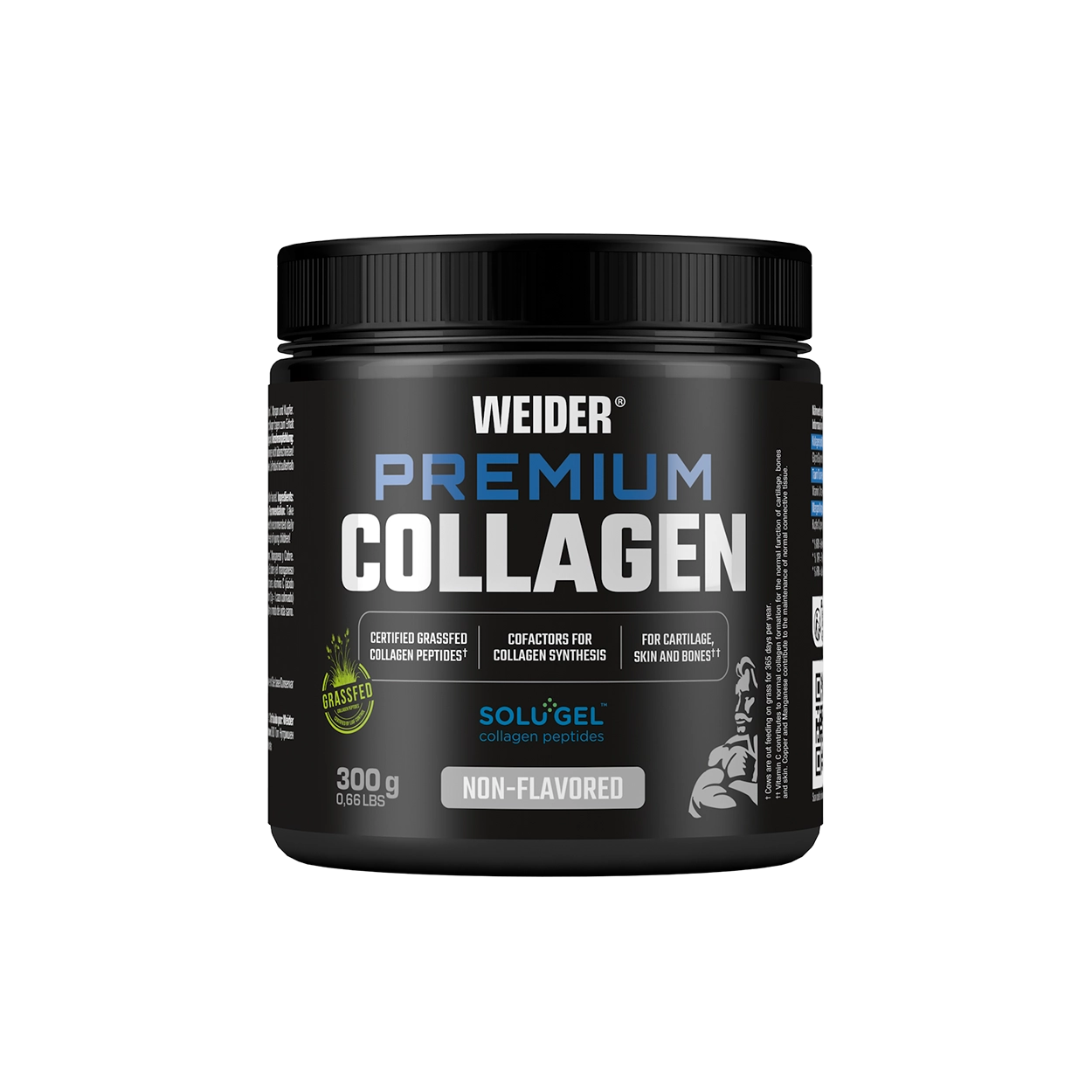
To coincide with the product launch of our new Premium Collagen Powder, today's WEIDER education will give you a closer look at the basics of collagen. So what are we waiting for – let's dive straight into this exciting topic without further ado.
The Essentials in Brief
For the social media generation with slightly limited attention spans, we'll start with a bullet-point summary:
- Collagen is the most abundant protein in the human body
- Collagen is a structural protein that gives bones, cartilage, teeth, tendons, ligaments, vessel walls, and skin their shape and texture
- Accordingly, collagen supplementation can potentially have a positive effect on all these tissues
- Studies show a positive effect on joint pain and the maintenance of articular cartilage
- Cosmetic parameters such as skin moisture and wrinkle depth could also be improved in studies through collagen supplementation
- Every third amino acid in fibrillar collagens is glycine
- Consequently, adequate glycine availability is crucial for functional collagen synthesis
- There are 28 types of collagen, but the type of raw material is most likely irrelevant due to the chemical breakdown of collagen
It's worth reading this article to the end – trust us…
From Slaughter Waste to Beauty Darling
Once decried as slaughter waste and a worthless byproduct of the food industry, the tide has turned 180 degrees regarding the popularity of collagen thanks to some scientific work. This is hardly surprising, considering that collagen accounts for approximately 25–30% of the total protein content of our body, making it the most abundant protein.
As with all proteins, collagen is initially a long chain of amino acids (primary structure). The most common amino acids in collagenous proteins are glycine (~35%), alanine, proline, and hydroxyproline.
In previous blog articles on essential amino acids (EAAs), we already learned that (muscle) protein synthesis requires all nine essential amino acids to function properly. L-Leucine as a "trigger" and the other eight as building material. The complete presence of the nine essential amino acids is also the main criterion for evaluating the quality of a protein.
Although collagenous protein indeed lacks the (essential) amino acid L-tryptophan, which, according to Liebig's Law of the Minimum, makes it an incomplete protein, this initially says nothing about its physiological benefit. After all, the collagen consumed is primarily intended to increase the production of the body's own collagen – for which it does not require L-tryptophan.
So far so good. Now that we have cleared away the negative image, we can start with the actual content. First of all, it must be said that this blog article only scratches the surface regarding the diverse effects of collagen supplementation. There is much more to discover and research here – so if you want to become an internationally recognized collagen researcher, you will have to become a bit more autodidactic. The original literature in our bibliography is excellent for getting started. Okay, enough small talk, let's get down to business:
What is Collagen Anyway?
Collagen is an extracellular (i.e., outside the cells) structural protein (so-called scleroprotein or scaffold protein) that gives tissues such as bones, cartilage, teeth, tendons, ligaments, vessel walls, and skin their shape and texture. Collagenous proteins are divided into 28 types, of which types I–III (all "fibrillar," i.e., composed of fibers) are probably the most important (Ricard-Blum 2011; Mienaltowski and Birk 2014).
While type I is mainly found in tendons and ligaments, type II collagen is also present in articular cartilage (Mienaltowski and Birk 2014). Type III collagen is a type of collagen that occurs primarily in embryonic development but is also found in adults in the skin and some organs (especially hollow organs such as large blood vessels, the bladder, the placenta, and adipose tissue) (Mienaltowski and Birk 2014; Kuivaniemi and Tromp 2019). Type III is also often found in tissues and structures where types I & II are also present.
Glycine – The Key Amino Acid in Collagen Synthesis
As already mentioned, collagens are the most abundant proteins in our body. The physical properties of collagenous proteins are due to their structure. Glycine, the most common amino acid in collagen, plays a key role here:
Glycine is the smallest amino acid and also the simplest in terms of chemical structure. Due to its small size, glycine allows for the formation of a so-called triple helix structure, which gives the structural protein its tensile strength. Given the high glycine content, it is not surprising that this small amino acid plays an important role in collagen synthesis.
An in vitro ("in test tube") study by Patricia de Paz-Lugo from 2018 showed that treating cartilage cells (chondrocytes) with the amino acid glycine could increase collagen synthesis (de Paz-Lugo et al. 2018). The authors even go so far as to say that, due to its importance for collagen synthesis, glycine should be consumed in large quantities through food and that it is therefore an essential amino acid (Melendez-Hevia et al. 2009). Since glycine, in addition to its function as a building block for collagen and other proteins in our body, also performs other tasks (such as the synthesis of the popular strength-enhancing creatine or the strong antioxidant glutathione), a chronic deficiency can negatively affect (metabolic) health accordingly (Li and Wu 2018).
In their experiment, the authors around de Paz-Lugo applied various concentrations of different amino acids (glycine, proline, lysine, isoleucine, and aspartic acid) to the cells and investigated the stimulated collagen synthesis over time. After 15 days, glycine in various dosages reliably increased collagen synthesis by up to 250% compared to the (untreated) control group. It should be noted that the cell culture medium of the control group also contained smaller amounts of glycine, proline, and lysine.
Furthermore, there is evidence that glycine induces the synthesis of collagen (and other molecules) in inflamed Achilles tendons, thus promoting "remodeling," i.e., structural rebuilding or regeneration (Pedrozo Vieira et al. 2015). The tendons of rats fed with glycine showed higher mechanical load capacity after treatment, which led the authors to conclude that glycine supplementation could be a sensible and effective treatment for such complaints.
A very interesting study from 1999 shows, on the one hand, the absorption of the supplied collagen and, on the other hand, its accumulation in the articular cartilage. The authors around Steffen Oesser fed radioactively labeled hydrolyzed collagen to mice to determine the accumulation of radioactivity in various tissues after treatment. Indeed, it could be shown that radioactivity in the cartilage was clearly measurable, which suggests the incorporation of the labeled building blocks into the articular cartilage (Oesser et al. 1999).
If a combination of collagen and vitamin C is taken before physical activity, collagen synthesis can be increased, which can play a significant role in injury prevention and tissue regeneration. These results were obtained by a research group around Gregory Shaw in 2017. It is interesting to note that this study was carried out with gelatin, i.e. intact, non-hydrolyzed collagen.
It should also be noted here that, in addition to taking collagen or its amino acids, physical exercise alone stimulates the synthesis rate of connective tissue. Conversely, physical inactivity ensures that the production of new collagen molecules is reduced (Holwerda and van Loon 2022).
What Does Science Say? Joints and Cartilage
We have already clarified what tasks collagen performs in the human body and what special significance the amino acid glycine has. Due to the frequency of collagen and its widespread presence in various tissues (skin, bones, cartilage, blood vessels, etc.), it is almost obvious that the intake of collagen brings numerous different positive effects – but what does science say about this? Let's take a look at one or two publications:
A fairly recent review by Martinez-Puig and colleagues from 2023 deals with the influence of collagen intake on joint health, especially the symptoms of osteoarthritis. Osteoarthritis is a chronic degenerative joint disease (caused by wear and tear or inflammatory processes) that, due to increasing life expectancy (it is an age-related disease), is now one of the most common joint diseases (Martinez-Puig et al. 2023).
After the ingestion of hydrolyzed collagen, free amino acids, as well as di- and tripeptides, are absorbed in the small intestine. In vitro and in vivo studies indicate a chondroprotective (cartilage-protecting) effect of supplementation. Clinical studies with collagen hydrolysate resulted in improved symptoms and increased proteoglycan content in knee cartilage in osteoarthritis patients, as well as reduced joint pain during exercise and at rest in healthy patients (Martinez-Puig et al. 2023). Despite the heterogeneity of study designs (dosages, treatment duration, etc.), the authors conclude that the majority of interventions lead to a positive outcome – and without any side effects. As is often the case, the scientists also summarize that further data are necessary for a conclusive evaluation. We know that. Honvo and colleagues and the working group around Chun-Ru Lin come to a similar conclusion (Honvo et al. 2020; Lin et al. 2023).
A study by Zdzieblik and colleagues showed that the daily intake of 5 g of special collagen peptides (hydrolyzed type I collagen) over 12 weeks could alleviate activity-related knee pain in young adults. Interestingly, the authors hypothesize that the collagen peptides used in studies are too heterogeneous to generalize a positive effect of collagen supplementation. More on this at the end of this article.
Collagen for Skin, Hair, and Nails
Collagen is also a hotly debated topic in the field of nutricosmetics. Numerous studies show a positive influence of collagen intake on the health and function of skin, hair, and nails.
For example, the regular intake of collagen peptides can improve signs of skin aging (Asserin et al. 2015). The ingested collagen peptides were able to significantly improve skin hydration and also increase collagen density in the dermis, the second skin layer (the epidermis is the uppermost skin layer). With increasing age, the water content in the skin decreases. In the study by Asserin and colleagues, skin moisture could be increased by up to 28% after eight weeks of collagen intake compared to the placebo group.
Kim and colleagues published their results in 2018 regarding an investigation into the influence of collagen supplementation on the hydration, elasticity, and wrinkle structure of the skin (Kim et al. 2018). In fact, the 12-week collagen intake improved all parameters investigated. With regard to this data, it should be noted that a fish collagen hydrolysate with a tripeptide content of >15% (three connected amino acids) was used – but only in a very low dosage of 1000 mg per day. Since the body can absorb di- and tripeptides in the small intestine in addition to free amino acids, the authors suspect that special peptides (Gly-Pro-Hyp, i.e., glycine, proline, and the hydroxyproline characteristic of collagen) could be responsible for the effect. The dipeptide from proline and hydroxyproline (Pro-Hyp) cannot be cleaved by the enzyme peptidase and therefore always appears intact in the blood. Other data suggest that this dipeptide may stimulate the growth of fibroblasts (collagen-forming cells) in the skin.
Perhaps it is due to the market potential of the beauty industry that the influence of collagen intake on skin texture is extensively researched – whatever the case, the data situation in this regard can be rated as very positive (Barati et al. 2020; de Miranda et al. 2021).
Wound Healing and Rehabilitation
Apart from acute/chronic joint problems and for beauty purposes, collagen supplementation can also support wound healing and rehabilitation after a musculoskeletal injury (Khatri et al. 2021; Mathew-Steiner et al. 2021).
Which Collagen Type is the Best?
Finally, we would like to address a frequently asked question. Many competitors praise the respective collagen type of the raw material on their product packaging. As already mentioned, there are a total of 28 different collagen types (Mienaltowski and Birk 2014; Martinez-Puig et al. 2023). But which collagen type is the best for effective supplementation?
Most commercially available collagen hydrolysates or peptides are derived from types I, II, or III. However, since these are, as already mentioned, hydrolyzed (i.e., chemically cleaved by hydrolysis) collagens, the type as a quality feature is most likely irrelevant. As also already mentioned, collagen, like every protein, consists of a long chain of amino acids arranged in the form of a helix. Each collagen molecule (with the exception of two types) consists of over 1000 amino acids (Gordon and Hahn 2010; Kuivaniemi and Tromp 2019; Naomi et al. 2021). The amino acid compositions of the individual alpha chains (three alpha chains form a helix) of collagen types I–III are very similar (Holwerda and van Loon 2021). Since only shorter amino acid chains (peptides) and free amino acids are present after cleavage, these are no longer immunologically active (like intact collagens) and can therefore no longer be typed (Martinez-Puig et al. 2023). It is therefore unlikely that the collagen type of the raw material plays a significant role in terms of its effectiveness in supplementation. On the other hand, some authors are of the opinion that the effect of special peptides (instead of whole peptide mixtures) must be evaluated in the future to answer this question conclusively. This is contrasted by the fact that numerous studies with collagen treatment, regardless of the collagen type used, lead to a positive result.
Conclusion
Well, that was admittedly a lot of input for a simple blog article – but what has to be done, has to be done. We hope to have brought the topic of collagen a little closer to you. We would also be pleased to have aroused your interest – for a more in-depth literature search or for a self-experiment. To support the latter appropriately, we are giving you a full 20% off our new Premium Collagen Powder with the code COLLAGEN*. All in the name of science.
* Valid from August 29th to November 30th, 2026 on Premium Collagen (300 g).









Share:
Training Planning: How long should you rest between sets?
EAAs Under Scrutiny: What the ISSN Position Paper Says About Essential Amino Acids